- info@avis.sk
- Telephone
- +421 2 20 30 2100
When the service car costs, so does the business: why short-term rentals are growing in importance
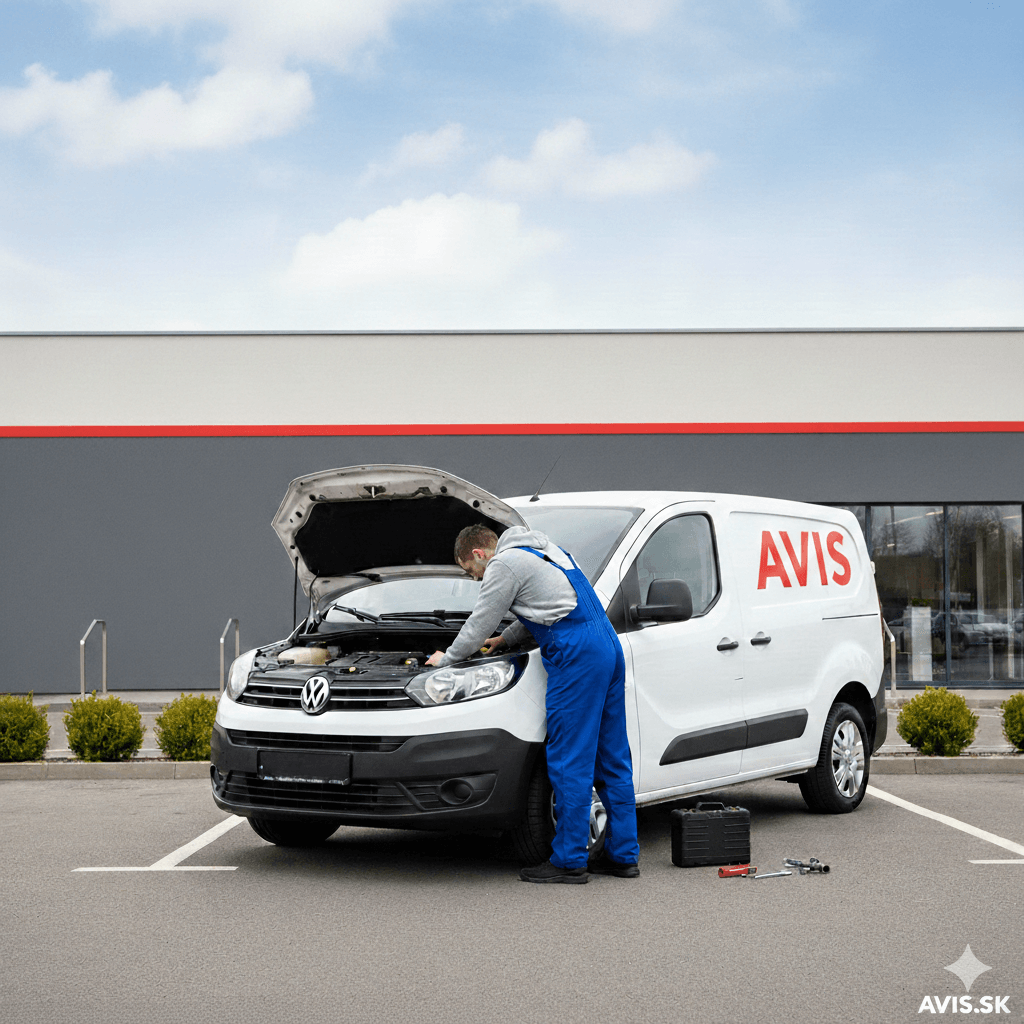
Service companies live on the availability of people and cars. If a vehicle is in the shop, on the MOT, in an accident or waiting for a part, interventions, SLAs and billing are all at risk. Short-term rental (1-365 days) is therefore increasingly being used as an 'airbag' for business mobility - a quick replacement with no tie-ups, no CAPEX and no waiting for a new car to be delivered. In this article, we'll review the data, compare the options (own fleet vs. rent vs. lease), and give practical guidance on how to set up replacement vehicles as a service.
- Why the spare service car is critical infrastructure today
Service vehicles aren't "peripherals" - they're working tools that hold both your customer traffic and your cash flow. A car outage typically doesn't just cause a deadline to be moved, it chains itself together:
- Missed intervention or installation (lost sales/penalties)
- SLA disruption (deterioration of reputation and contract renewals)
- technician transfers between cars (lower productivity)
- stress in dispatching (more communication, more errors)
- pressure for "temporary solutions" (private car, taxi, improvisation)
When the risk of failure is highest
- Seasonal peaks (heating/cooling, water breakdowns, power failures)
- Winter and weather extremes (accidents, harsher conditions, higher wear and tear)
- projects with tight schedules (construction and installation work)
- service windows at clients (manufacturing, retail, critical infrastructure)
2) Data from Slovakia and the EU: why the pressure for car availability is higher
Slovakia: lots of cars, increasing age and a significant gap between companies and households
From the perspective of service companies, three facts are key:
- There were approximately 3.4 million vehicles registered in Slovakia at the end of 2024, of which almost 2.74 million were passenger cars (M1).
- Deliveries up to 3.5 t (typical working segment) accounted for approximately 294 thousand units.
- The average age of passenger cars was around 13.9 years, with individuals averaging around 15.6 years and legal persons + sole traders around 7 years.
What does this imply for service companies:
- company cars are younger, but they are "more heavily used" - and thus more sensitive to downtime
- households often drive older cars, which increases accident/ breakdown rates in the area (and increases demand for interventions)
- the van segment is large, but not always available "right away" in the required equipment
EU: ageing fleet = more breakdowns and service interventions
According to European statistics, cars in the EU are on average older than a decade ago. The average age of passenger cars in the EU is around 12.3 years and for light commercial vehicles (vans/LCVs) around 12.5 years.
Practical impact:
- Older vehicles are more likely to have unscheduled repairs
- for vans and service cars, the availability of parts (and thus the length of repair) is often critical
Rental market is growing as companies buy flexibility
An interesting signal from Europe: in H1 2024, registrations of vehicles for short-term rentals in Europe grew by around 24% year-on-year. What this means for practice is that more and more companies are addressing mobility as a service - not as an asset.
How much does car downtime cost: the difference between a "cost" and a "loss"
When a service car is out of service, you are often dealing with two items:
- Direct cost: towing, diagnostics, repairs, spare parts.
- Indirect impact: lost work, missed appointments, technician transfers, penalties.
International estimates (different sectors, different methodologies) put the cost of unplanned downtime typically in the hundreds of euros/dollars per vehicle per day. As an indicative benchmark, the following is often quoted, for example:
- USD 448-760/day/vehicle (fleet outage cost estimates cited in the literature and fleet blogs),
- UK LCV benchmark: research reported in the fleet environment works with an average of around GBP 800/day of lost performance per unavailable vehicle and an annual impact in billions of GBP.
For service companies, the bottom line is important: just a few days of downtime can cost more than a short-term rental of a replacement vehicle.
3) What exactly does "short-term rental as a replacement for a service car" mean
Short-term rental in this context means that the vehicle:
- you can deploy quickly (often within hours to days)
- does not tie up capital (CAPEX) or long-term liability
- you can extend or terminate it according to the real length of the repair/event
Typical scenarios where a lease acts as a replacement
- Car is in an accident (waiting for inspection/parts)
- car is in for a longer repair (engine, transmission, electrical, ADAS calibration)
- temporary increase in interventions (season, breakdowns, project)
- new technician "on board right away", car not yet delivered
- temporary replacement of a van (logistics, materials, tools)
4) Comparison of solutions: own fleet vs. short-term rental vs. medium-term rental vs. operating lease
To make the decision-making process quick, use a simple rule of thumb: "Horizon of need + level of uncertainty".
Quick table (practical summary)
- Own fleet (purchase/loan/financial lease)
- Advantage: long term lowest cost per day with high availability
- Disadvantage: CAPEX, residual value risk, service "load", downtime handled internally
- Short-term lease (1-365 days)
- Advantage: immediate availability, no commitment, ideal for replacements and urgent
- Disadvantage: higher daily cost than long contracts
- Medium/long term rental (typically 2-12 months; in practice longer depending on the product)
- Advantage: better price than short term, still flexible, suitable as a 'bridge' for deliveries
- Disadvantage: less suitable for 3-7 day outages (if you only need a car "for a while")
- Operating lease (36-72 months)
- Advantage: predictable monthly cost, outsourced fleet management
- Disadvantage: tie-in and less flexibility in number of cars
Practical advice for service companies
If you don't know whether there will be a 5 day or 5 week outage, start short term and have a switch to medium term ready. In practice, this saves time and nerves.
5) How to set up spare service cars to work as a service (SLA)
The biggest mistake is to deal with "ad hoc" replacements only when the car is stationary. Companies that have a pre-agreed framework have the best results.
Step 1: Define categories and minimum equipment (not a specific model)
Recommended course of action:
- Define 3-5 categories (e.g., station wagon; small SUV/4×4; LCV 6-9 mpg; LCV 10-13 mpg; LCV 14-16 mpg)
- Specify mandatory equipment (towing; roof rack; winter tyres; automatic; navigation; 3-seater in front; air conditioning)
- for vans, specify min. volume and load capacity + access height (underground garages vs. sheds)
Step 2: Agree on the logistics of the exchange (where, when, who takes over)
- pickup at branch vs. delivery to site
- exact persons authorized to pick up the vehicle (dispatcher, operations manager)
- time windows (e.g. "same day within 2 hours" for critical interventions)
Step 3: Set up damages, insurance, and processes (so it doesn't stop operations)
- Internal "check-in/check-out" (photos, mileage status, fuel)
- rules for minor damage and accident reporting
- 24/7 assistance contact
Step 4: Link rental to dispatching and reporting
- who decides on the deployment of a replacement car (criteria: SLA, revenue, distance)
- Simple reporting: number of outages, days out of service, reasons, costs, "precautionary measures"
- Goal: reduce unplanned downtime while having a replacement ready
6) The investment view: when renting pays off financially
With service companies, renting often pays off even sooner than it seems - because you're comparing the "rental price" against the "downtime loss", not the "car payment".
A simple break-even model (practical)
Consider these three variables:
- D = estimate of downtime loss per day (e.g. lost margin + transfers + penalties)
- R = cost of replacement vehicle per day (or equivalent per month)
- T = number of days of downtime
If D × T > R × T, hiring makes sense.
Example (simplified):
- 10 days of supply outage
- even a conservative loss of 150 € / day (1-2 interventions per day, technician transfers)
- Renting a "bridge" for 1 month in the LCV segment can be comparable to one major missed order
Note: For deliveries, it is often economically advantageous to switch to a medium-term mode (e.g. 1 month) especially when it is uncertain when the repair will be completed.
CAPEX vs. OPEX: what it means for service companies
- Own car = capital tied up in asset + residual value risk + internal processes
- Lease = variable cost as needed + quick scalability + less administration
In practice, therefore, more and more companies are leaning towards hybrid:
- Core fleet owned or operating lease (stable demand)
- "buffer" (replacements, peaks, projects) handled in the short/medium term
7) Trends 2024-2026 that increase the importance of replacement vehicles
- Increased technical complexity of cars: even "banal" repairs take longer (diagnostics, electronics, calibrations).
- Lack of technicians and service capacity: ordering times in workshops are longer at peak times.
- Volatility of service demand: weather, construction season, clients' investments.
- Pressure for TCO and transparent costs: companies want to see the total impact, not just "how much a day costs".
8) How you can put it together in AVIS (practically)
Under one tag you can combine multiple modes according to the situation:
Short-term rental (AVIS)
Suitable for:
- Urgent replacements (accident, downtime, quick reinforcement)
- 1-14 days, when you need a car "right away" and don't know the exact length
Vans and commercial vehicles (AVIS Van Rental)
Suitable for:
- Service and assembly teams with tools and materials
- Different van sizes according to volume (from smaller to large vans)
Medium/long term rental (AVIS MaxiRent)
Suitable for:
- "bridge" for new car deliveries
- projects and seasons (2-12 months)
- Situations where the repair is longer and you don't want to pay a short-term price
Operating lease and fleet management (AVIS Lease)
Suitable for:
- Stable fleets (typically from 15 cars upwards)
- Outsourcing of fleet management and administration
Frequently Asked Questions (FAQ)
- What is the best way to have a spare car "within hours"?
A framework agreement for vehicle categories + pre-determined pick-up persons works best. Then you are only dealing with availability and logistics, not paperwork.
2) When is a short-term rental worth it and when is a medium-term rental better?
Short term when you need a car immediately and don't know the length of downtime. If the outage stretches into weeks, it often makes sense to switch to medium-term.
3) Is renting suitable for service vans with tools?
Yes - getting the category (volume/capacity) and equipment (e.g. 3-seat front, towing, winter gear) right and clear rules for loading and securing cargo are key.
4) How to deal with insurance and damage so it doesn't stop operations?
Have an internal procedure for handover and acceptance, photo documentation and one responsible person (fleet/dispatch). In an accident, speed of reporting and proper documentation is critical.
5) Can hiring be addressed by hiring new technicians without waiting for a car?
Yes - hiring is often the fastest way to get a new person "in the car" and not start performance until 2-4 months later.
TL;DR (summary in 3-5 points)
- Service vehicles are critical infrastructure - downtime threatens both SLA and revenue.
- Slovakia has an aging fleet; company cars are younger but more heavily used, so downtime hurts more.
- Replacement via short-term rental works as a "buffer" - fast, no tie-up and no CAPEX.
- Companies that have a framework up front get the best results: categories, equipment, logistics and processes.
- Hybrid is the new standard: core fleet long term, replacements and spikes flexibly.
Keywords and entities (used and related)
Main KW
- service vehicles
- corporate mobility
- short-term rental
Related KW and entities
- replacement vehicle, vehicle downtime, SLA, TCO, CAPEX, OPEX
- vans / LCVs, service network, 24/7 assistance
- AVIS, AVIS Van Rental, AVIS MaxiRent, AVIS Lease, Payless
- fleet management, dispatching, seasonality, project mobility
Conclusion
If a service vehicle costs money, so does part of your business. Today, short-term rentals are a practical way to keep businesses mobile during unplanned events - without long commitments and without tying up capital unnecessarily. You get the most value when you set up reimbursements systematically: categories, equipment, logistics and internal processes.
Resources (Slovakia + abroad)
- ACEA: average age of the vehicle fleet in the EU (passenger cars ~12.3 years; LCVs ~12.5 years).
- Financial Policy Institute (IFP) analysis cited in Slovak media: number of vehicles in Slovakia, share of categories, average age (including difference between natural and legal persons).
- Dataforce / FleetEurope: development of short-term rental vehicle registrations in Europe (H1 2024: ~+24% yoy).
- Platform Science / Chevin Fleet: international estimates of vehicle downtime costs (different methodologies; suitable as indicative benchmarks).
- EEA (European Environment Agency): car lifetime context and regional differences.
- AVIS blog (avis.sk) and content of AVIS product pages: short-term rental, MaxiRent, AVIS Lease and expectations of corporate customers (SLA, TCO, availability).
